Phylogenetic relationships near the origin of crown birds

Crane et al 2025 sought to clarify phylogenetic relationships
near the origin of crown birds by looking at mandibular morphology.

To long-time readers, this focus on just a few traits around the mandible sounds like “Pulling a Larry Martin.” Better to employ traits from mandible to tail and toes in any analysis… and employ more taxa than necessary.

Since this was an article ‘in press’
that means feedback is encouraged. So I wrote to the authors:

You wrote: “We find that evidence from Asteriornis fails to support interpretations of derived mandibular similarities with palaeognaths, and instead strongly favours galloanseran, and specifically galliform, affinities.”

This trait-based online cladogram supports that result:  http://reptileevolution.com/reptile-tree.htm …but does not recover the genomic clade Galloanseres. Instead chickens and their seed-eating allies nest far from water-tied geese and their allies, including Asteriornis.

You also wrote, “Our results also illustrate striking similarities in the architecture of the lower jaws between the toothed ornithurine Ichthyornis, Pelagornithidae and Vegavis, which, in addition to the absence of derived features linking them to Galloanserae, highlights questions regarding the phylogenetic position of these perennially controversial taxa.”

That same cladogram nests Pelagornis with Morus far from Ichthyornis. Vegavis nests among the most basal birds, close to Pseudocrypturus, again far from Ichthyornis.

The last common ancestor of crown birds in this trait-based cladogram is Early Cretaceous Archaeorhynchus. That gives almost the entire Cretaceous for birds to diversify and radiate across closer continents, despite the current paucity of supporting fossils. That’s how we get terror birds in South America derived from African secretary birds. That’s how we get highly derived New Zealand penguins in the Paleocene. That’s how we get ratites in all the former Gondwanaland continents. That’s how we get flightless kiwis restricted to New Zealand with their closest trait-based relatives, the woodcock and snipe, radiating elsewhere.

Hope this helps.
Best regards,
David Peters

To long-time readers
this comment on their paper represents the scientific method. The authors’ analysis was repeated using the LRT, but with the addition of more taxa and more characters. Results differed. That’s all you need to say. That gives the authors guidance with a suggested method. It’s up to them to add characters and taxa.

Note: I did not strip down the LRT to exactly repeat their experiment with just mandibular characters. That would be like taking away the steering wheel and gas tank from an automobile and expecting it to continue to work the same way. I am surprised that such a stripped down experiment focused on just the mandible was proposed let alone executed and submitted.

Editors note: I see I have four comments waiting in the queue. I have not looked at them, nor will I do so for a day or three while I work elsewhere on other issues. Apologies for the delay. Thank you for your patience.

References
Crane et al (4 co-authors) 2025. Mandibular morphology clarifies phylogenetic
relationships near the origin of crown birds. BMC Ecology and Evolution Article in Press. https://doi.org/10.1186/s12862-025-02487-4

To Stu Bonk: response to reply to comment

A Response to David Peters’s Newest Post Replying to Me

“Please note the axis of the acetabulum is lateral. The axis of the femoral head is medial. Those align.”

While yes, those typically align, either the femur isn’t in a proper lateral view or there’s something wrong with the femoral head as it should at least be similar in shape to the acetabulum. The most apparent case (Fig. 1) shows a large chunk of the femoral head not even in the acetabulum at all. Along with this, if this femoral head were to slot into the acetabulum, it would at most fill about half of the acetabulum. Also, regardless of the validity of anything I just said, the femoral head absolutely should not be at the side of the femur. It should be above that flat portion.

>> Stu: a few things here: 1. Please see https://www.reptileevolution.com/sharovipteryx2.htm for images of the plate and counterplate. Note that the femur appears on both, split in half the long way to reveal its hollow interior. Note the femoral head is layered with sacrals and pelves. Note the traced femoral head is broader than shown in the animation and lacks a femoral neck. In the animation some foreshortening was applied to the left hind limb in order to show its lateral-ish configuration.That foreshortening appears to have migrated to the too-small femoral head. My bad. Your good eye.

For closer imagery see: https://www.researchgate.net/publication/328388115_Cosesaurus_aviceps_Sharovipteryx_mirabilis_and_Longisquama_insignis_Reinterpreted

Figure 1. One of the frames in David’s Sharovipteryx running animation in which the femoral head appears to be too far removed from the acetabulum.

>> Stu, do me a favor and mentally push that femoral head deeper into the acetabulum. I attempted to show both rather than hide the head in the acetabulum. My mistake. Note the foreshortening in this image. That means distortion when dealing with a 2D  = flat original.

“Are you saying I was a mm off on the one, but okay on the others?”

Yes and no. I couldn’t really tell you if the frames I didn’t acknowledge were off as it’s a bit hard to judge when it comes to them (especially considering that the femoral head doesn’t fit the acetabulum). The frames I picked out were the ones with the most noticeable issues with the positioning of the femoral head.

“Have any done comparisons to lepidosaur musculature? or did they use birds? Or did they use muscle attachment points? If so, how did the prepubis figure into their restorations = best guesses?”

It varies on the paper. Buchmann and Rodrigues, 2025 attempted to simulate pterosaur cervical musculature through comparisons to birds and crocodilians. Bennet, 2008 used muscle scars in order to simulate forelimb musculature in Anhanguera. From what I can tell, the portion of New Perspectives on Pterosaur Palaeobiology reconstructing the hindlimb musculature of Vectidraco uses both muscle scars and comparisons to extant archosaurs. Costa et al., 2013 simulated pterosaur hindlimb musculature in Anhanguera using 3d modeling software, muscle scars present in Pteranodon, and comparisons to modern archosaurs. Griffin et al., 2024 utilized all previous muscle simulations of Anhanguera along with in-person examination in order to simulate the full body musculature of the taxon.

In the cases of both Anhanguera and Vectidraco, the presence of the prepubis was not factored in as there is no evidence supporting its presence in those taxa and there don’t appear to be any signs of breakage where the prepubis would connect to the hip.

>>Stu: So, your answer is ‘no’. No comparisons to lepidosaurs. Vecticodraco is a protorosaur in analysis, so not related to pterosaurs, yet bipedal by convergence. [Ed note: from 1/06.26 I was thinking of Venetoraptor gassenae, a protorosaur from the Late Triassic. My mistake. Vecticodraco is a pelvis and sacrum from an Early Cretaceous pterosaur, detailed here: https://en.wikipedia.org/wiki/Vectidraco  and it probably had a prepubis based on phylogenetic bracketing.] Ever wonder why Anhanguera is the only pterosaur without a prepubis? Possibly related to its also unique tiny feet – whatever tiny feet means with regard to pterosaur locomotion.

“Peer review rarely if ever employs the scientific method. By that I mean have you ever seen or heard of any referee repeating the experiment (= repeating the animation) or observation = requesting the specimen for their own examination.”

To my knowledge, the extent as to what happens in peer-review varies from paper-to-paper. Some will suggest additions to the paper, suggest clarification on certain portions of it, or state that you need to substantiate claims made more. Some reviewers will examine the fossil themselves and tell you if you described certain portions of the specimen incorrectly. Also, the reason why reviewers won’t always repeat exactly what the paper they’re reviewing did is because sometimes the methodology required to repeat the research in the study may take months or years to conduct alongside a decent sum of money (this wouldn’t be a problem if the reviewers had funding to do this, but they don’t).

>>Stu: Please provide evidence for “Some reviewers will examine the fossil themselves and tell you if you described certain portions of the specimen incorrectly.” I have never heard of that. I’d like to know. Submit a manuscript someday and see how the process actually works, as I have.

“One said, “you didn’t look at the fossil long enough.’ On another paper the same referee, David Hone, wrote, “you didn’t examine the specimens a second time.” See what I mean? This is reality. This is gatekeeping. You’re going to have to put away your ideals when it comes to paleontologists.”

The examples you provided are not gatekeeping, they are requests for you to reexamine the fossils you’re publishing on as, depending how long David Hone has studied the fossils in question, he may be right as he might’ve studied the fossils over a longer period of time and with more scientific rigor than you did. Also, if you did not examine the fossils in-person, Hone is correct that you should reexamine the fossils as while photographs are good, they won’t give you the same amount of detail that examining it in person does. That is just good protocol.

>>Stu: Please provide evidence for “David Hone has studied the fossils in question,” He has never indicated that he ever examined the fossils in question. I  examined the fossils in question. I published on the fossils in question (Peters 2000). I had 8×10″ transparencies made of the data. In the rejected manuscript I was correcting earlier freshman errors in a follow-up paper. Do you see the bias in your judgement? You assumed incorrectly that professionals always operate professionallly. They are human. They are concerned with their status and interrelationships.

“Question: have you ever submitted a manuscript and figures for publication? A Yes or No will suffice.”

No, I have not, but I am aware of how the process typically works because I’m in frequent contact with a few paleontologists who do have experience publishing, getting peer-review, and giving peer-review.

>>Stu, your “aware”ness may be based on an ideal, and not correctly factor in the human status/emotion/ingroup vs outgroup factor that I have experience first hand with accepted and rejected manuscripts.

“When showing fossils as they lived and locomoted there is no ‘proof’. Only a hypothesis that then requires confirmation, refutation or modification.”

That is only somewhat correct. When it comes to locomotion, there are ways to tell for certain that an animal did or did not walk a certain way. In regards to the femur, it mainly comes from seeing how the femoral head slots into the acetabulum. If the head doesn’t slide in properly when at a certain angle, the animal didn’t walk with its femur in that position.

>> Stu, see above for tab and slot situation. Also see these blogposts on bipedal lizard tracks: https://pterosaurheresies.wordpress.com/2018/02/18/bipedal-cretaceous-lizard-tracks/ and https://pterosaurheresies.wordpress.com/2020/01/16/lepidosaur-bipedality-and-pelvis-morphology-grinham-and-norman-2019/

“I presented these arguments in 2011: https://pterosaurheresies.wordpress.com/2011/07/20/seven-problems-with-the-pterosaur-wing-launch-hypothesis/

Since you’re giving me a different post to reply to, I will make a separate post in order to respond to the claims in it.

“Please note that when pterosaurs quad launch they do so with wings folded (that makes it tough to use them for thrust and lift as in the competing bird-like launch hypothesis).” 

I have a problem with that claim. In Griffin et al., 2024, they used a crocodilian-like ankle for pterosaurs when simulating the different flight methods. Crocodilian ankles are undoubtably more similar to bird ankles than lepidosaur ankles. So, allow me to insert a quote here:

“As both crocodilians and pterosaurs are plantigrade (Mazin et al., 2003;Mazin & Pouech, 2020), and lack the tibiotarsus seen in birds, a crocodilian ankle mechanics approach may be a closer approximation if the ankle muscles were to be estimated. These studies found the moments produced by crocodiles to peak at be around half the peak moment of the knee (Wiseman et al., 2021) while birds tended to peak at moment values equal or greater than the knee (Meilak et al., 2021a;Meilak et al., 2021b). If such results are applied to pterosaurs, it is unlikely for either of the bipedal take-off motions reach an equivalent amount of leverage as that available to the quadrupedal launch motion without some utilisation of the greater leverage available in the forelimb.”

(Griffin et al., 2024)

Once again considering that crocodilian ankle muscles are more similar to bird ankle muscles than either are to lepidosaur ankle muscles, I’d say that the quadrupedal launch hypothesis does generate more leverage than the bird-like style of take off you are a proponent of for pterosaurs.

>> Stu: please address the issue I raised:they do so with wings folded (that makes it tough to use them for thrust and lift as in the competing bird-like launch hypothesis).” See Griffin 2024 figure 3 for their footless, fingerless image of this. With regard to ankles, pterosaurs and their ancestors share with dinosaurs a simple hinge ankle joint lacking a protruding heel = calcaneum (by convergence) whether produced with or without a tibiotarsus. The gracile bones of pterosaur feet are not similar to the robust feet in alligators, but more similar to those in birds.

“They do so with wing finger planted on the ground and stretching that tendon so it can snap back when released, like a grasshopper leg. That never happens. Never. Only the free fingers touch the substrate, so no tendon snap.”

What? Looking at Griffen et al., 2024 (the most comprehensive study simulating the quadrupedal launch hypothesis), there is no mention of a tendon snapping back. To my knowledge, that is in no way a part of the current quadrupedal launch hypothesis.

>> Stu, see https://pterosaurheresies.wordpress.com/2024/08/08/griffin-et-al-2024-choose-the-wrong-pterosaur-take-off-pose-again/  Griffin et al wrote: “the
quadrupedal launch hypothesis is partially inspired by vampire bat terrestrial take-offs (Habib 2008). Mike Habib explained the snapping tendon/grasshopper hypothesis to me via a set of emails before publication.Griffin et al wrote, “The second take-off motion is hereafter referred to as a bipedal burst take-off.” [note: their figure 3 shows this means the forelimbs are providing the burst because the hindlimbs (lacking feet) are way off the ground]. “This take-off begins already in a deep crouch and then rapidly extends the hind limbs with the body angled to launch nearly vertically while the wings start their initial downstroke.” [In their figure 3 the wings (lacking the three free fingers) cannot start their initial downstroke because the wings are folded and completely down. To start a downstroke, the wings must be up.] Please drop a note to Griffin et al to clarify their logic leap. Furthermore, “Commonly called vampire bats, these nocturnal flying mammals have a body length of roughly 3 in and a wingspan up to 15 in. They usually weigh 20–50 g” At the high end that is one-tenth of a pound. Scale that up to pterosaur size. Remind yourself that weight increases by the cube of length and at some point (you decide) flight will be improbably, then impossible given the wing loading to weight ratio.

“Doubt is not the scienfic method. Show how Quetz would not be able to stably run in that fashion. How heavy was the skull? What if it was made of something akin to styrafoam or balsa wood? Everything about pterosaurs was extremely thin and supported by needle-like internal struts where necessary.”

A few things:

  1. As I will continue to mention throughout this post, I will be attempting to definitively show that in a later post. I will work on it as soon as I get access to a paper with the necessary formulae to show if Quetz had bending strength and axial strength indexes aligning with bipedality.
  2. Considering the fact that skulls in non-cartilaginous fishes are made of bone, the skull of Quetz would not have been made of anything but solid bone, though it likely did have some air sacs in its skull (which unfortunately makes the weight of the skull fairly difficult to estimate).
  3. Despite pterosaurs having a build adapted to be light, Quetzalcoatlus northropi was still at least 330lbs/150kg (Padian et al., 2021).

>> Stu take a look a the skull of Quetz. It is full of holes. The bone part is crushed flat due to a hollow interior. Whatever the weight of the rest of Quetz, the skull and neck were hollow.

“I say Anhanguera was a poor runner based on having the smallest feet relative to body size of any pterosaur. Worse than all other pterosaurs.”

If it locomoted quadrupedally, Anhanguera would have been able to run as demonstrated by Ceroula et al., 2025. By the way, if Anhanguera can’t locomote well terrestrially while bipedal but can locomote highly efficiently while quadrupedal, isn’t that support for it being quadrupedal?

>>Stu, a few things… 1. I looked at Ceroula etal 2025 and did not see Anhanguera walking quadrupedally, only Rhamphorhynchus standing still (their figure 1, their only figure). Don’t tell me they demonstrated something when they did not. 2. The authors also wrote, “Pterodactyloid tracks reveal that handprints appear deeper in the sediment than footprints, indicating that most of the animal’s weight was borne by the forelimbs on the ground.” The authors do not mention that some tracks are manus-only tracks. Now what? We have to imagine those tracks were made in shallow water floating the torso and hindlimbs. 3. The authors omitted citations to Peters 2011, A Catalog of Pterosaur Pedes for Trackmaker Identification
Ichnos 18(2):114-141. Seems odd to omit that citation, unless it included counterpoint data. 4. Please see https://pterosaurheresies.wordpress.com/2022/08/26/u-of-bristol-workers-cheat-pterosaur-anatomy-again-create-a-frankensaur/ to see how far U of Bristol workers will go to achieve their objectives.

Also, quick question, how is your reconstruction of Anhanguera (Fig. 2) a bipedal animal? The hand and wing finger extended below the ground.

>>Stu: my bad – I made the repair. See: http://www.reptileevolution.com/anhanguera.htm

Figure 2. David Peters’s skeletal diagram of Anhanguera (source).

“Take another look at those feet. They are, if not vestiges, minimized. When young pterosaurs were able to fly shortly after hatching.”

No matter how little time they spent on the ground, they still would’ve needed the ability to locomote well terrestrially. They still need to do courtship, copulate, nest, and care for their eggs. All of these tasks require the ability to locomote well terrestrially.

>> Stu: you are ignoring the proposition: small feet. The smallest among pterosaurs. What does that mean to have such small feet?

“They had the proportions of an adult only 8x smaller. That is a rule that has not yet been broken based on available data.”

Even if they were, that doesn’t mean they didn’t spend a decent amount of their time on the ground when young.

>> Stu: you are deflecting the proposition: small feet. The smallest among pterosaurs. What does that mean to have such small feet?

“‘Those fibers are not the same’ is not an argument. It’s a denial without evidence. Please present data in the form of images from the fossil in Barcelona or your interpretation of photos.”

Well, according to Bennett, 2000, aktinofibrils (which is the correct spelling for the term) are made up of keratin, cartilage, or dense collagen which is distinct from the pycnofibers found on the bodies of pterosaurs. Also, by the way, aktinofibrils don’t make up the wing membrane as a whole. They only make up and reinforce the distal portion of the membrane (Jäger et al., 2018).

>> Stu: you are deflecting the proposition: fibers emanating from the posterior of the forelimb in Cosesaurus and pterosaurs.

“To your point, those fibers are shorter, as expected in a transitional taxa. Baby steps = microevolution. Feathers did not appear ready for flight on birds either.”

Considering that pycnofibers becoming aktinofibrils which became wing membrane isn’t support by the fact that they have different chemical compositions and aktinofibrils only make up a small portion of the wing membrane, I don’t think that’s an apt comparison.

>> Stu: you are deflecting the proposition: fibers emanating from the posterior of the forelimb in Cosesaurus and pterosaurs. And these fibers are only one trait after dozens identified in Peters 2000 and the unpublished manuscript cited above. No one said pycnofibers become aktinofibrils. You invented that myth.

“Please provide titles with citations, especially with authors with common last names. I presume you mean ‘Using your head — cranial steering in pterosaurs’, abstract available on ResearchGate.net.”

You are correct that the paper I was citing was Using your head — cranial steering in pterosaurs by Henderson, 2024. I was not just referencing the abstract though as I do have the pdf of the full text.

“Please note that Henderson is fond of using freehand cartoons for his pterosaurs and gives them deep chord wing membranes attached to the ankles. That gives him no authority to determine center of balance.”

Well, luckily for you, he doesn’t use freehand illustrations to determine the center of gravity in pterosaurs. Henderson used digital modeling to find the center of mass for 18 different pterosaurs. The centers of mass recovered in the paper align with how we currently reconstruct pterosaurs.

>> Stu, Henderson used freehand. Google: henderson 2024 “using your head”   to see images from that paper. He used freehand digital modeling. And what do you mean by ‘we currently reconstruct’? That’s vague. The Henderson images show a deep chord wing membrane NOT found in any fossils, yet approved by referees. This is corruption. Follow the money and status. It’s creepy in academia.

If you want to contest the results of the paper, you have to show that if the models used in the paper were accurate to your reconstructions of pterosaurs, their centers of mass would align with your hypothesis. Until then, your objections to the paper remain strictly opinion.

“Did I read this correctly? Pterosaurs were compared to rhinos and buffalo?”

Strictly in regards to their bending strength and axial strength indexes though, in all honesty, the paper itself phrases it better than I do:

“According to Alexander (1983), relatively high ACI values suggest agility and a more remarkable ability to move relatively fast. The indexes recovered here for the humerus and femur are similar to those of modern quadruped animals that can move with good agility and even run at high speed (Alexander 1985, 1989, Biewener 1990, Fariña 1995, Casinos 1996,Bargo et al. 2000) such as the white rhinoceros (Ceratotherium simum) and the water buffalo (Bubalus bubalis) (Alexander & Pond 1992)…  Although not indicating speed estimates, our results suggest that pterosaurs generally possessed limb bones capable of withstanding the mechanical stress of running, to the exception of the giant azhdarchid herein analyzed, Hatzegopteryx thambema (Table III).” 

>> Stu, let’s agree that rhinos and pteros should not be compared in locomotion studies.

(Ceroula et al., 2025)

“In any case, their figure 1 shows a Rhamphorhynchus about to take a drink of water – and a freehand cartoon as well.”

What? The skeletal restoration of Rhamphorynchus is meant to be in a standing posture for quadrupedal locomotion.

>> Stu, the skeletal cartoon restoration is not moving. It is not demonstrating quadrupedal locomotion. Please report that you have seen the bipedal Rhamphorhynchus specimens here: http://www.reptileevolution.com/rhamphorhynchus-to-scale.htm   Please note the variation in forelimb and hindlimb length. All are different from one another, some more than others.

“It is not in the configuration of a bipedal lizard.” 

I am working on finding the methods from a paper they cite going into bipedal locomotion so that I can check if the sampled pterosaurs from Ceroula et al., 2025 could efficiently move bipedally.

“And they don’t fly!!”

This is a paper on terrestrial locomotion. Why would they show it flying?

>> Stu, please remind yourself that if pterosaurs and their ancestors were typical quadrupeds, then at some point simultaneous flapping = flying has to appear. That never happens with left-right-left-right quadrupedal locomotion. A biped must be present when flapping appears. Pterosaurs have wings. That’s why they should show locomotion that can possibly lead to flight. Presently the workers you follow have not produced pterosaur ancestors that were quadrupeds with wings and had the long list of competing synapomorphies presented by Peters 2000 and later works.

If this is in response to my mentioning of the part of Ceroula et al., 2025 stating the paper’s results support the quadrupedal launch hypothesis, here is the full excerpt:

“The relative robustness of the forelimbs of pterosaurs, especially pterodactyloids, has also led to the hypothesis that these animals could take off from quadrupedal launch using primarily the forelimbs for thrust (Habib 2008, Molnar 2009, Witton & Habib 2010, Benson et al. 2014, Witton 2015, Padian et al. 2021, Griffin et al. 2022, 2024). Our results support this hypothesis, as according to Alexander (1985), higher ACI values for a given limb indicate a greater capacity to support larger fractions of the animal’s weight, so the humerus could help the load exerted during take-off.”

“Here is a basal pterosaur, Bergamodactylus. Show me how this pterosaur locomoted quadrupedally:”

So, I attempted to put your Bergamodactylus skeletal into the position of a quadruped and it didn’t exactly turn out right (Fig. 3). But I do know why it looks off.

Figure 3. My hour-long attempt to repose David Peters’s Bergamodactylus skeletal to match quadrupedal reconstructions.
So, I was looking into the actual measurements of Bergamodactylus which happen to be in Kellner, 2015. What do you think the measurements taken from the actual specimen in person are? Well, the humerus has a length of 26.3mm/1.04in and the femur has a length of 18.5mm/0.73in, meaning your skeletal reconstruction of Bergamodactylus (found here) is inaccurate. This is actually supported by your own digital examination of MPUM 6009 (Fig. 4) in which you can tell that the femur is shorter than the humerus.
>> Stu, you made a simple mistake. You did not read the captions, nor did you scroll to the second and third images on the webpage. The first image, the one you showed is the Wild 1978 tracing applied to the insitu fossil. That tracing is incomplete, but the pterosaur is complete. That page of images has now been replaced with a single GIF movie of three frames each lasting 2 seconds. One frame now has the complete pterosaur traced in DGS colors along with the Wild tracing and another frame for the sternal complex and pelves. Bergamodactylus has longer legs than Kellner and Wild identified. Please note that many bones are represented by impressions and many bones overlap others, creating a real mess if you just use your eyes. That’s why DGS (digital graphic segregation) was used to recover all the bones and soft tissue from thiis otherwise difficult fossil to understand. See: https://www.reptileevolution.com/MPUM6009-2.htm  If you can’t see the ‘missing’ bones that’s OK. It takes the correct lighting. On Cosesaurus I have rotated the specimen to see a humerus appear and disappear atop the vertebral column.
Figure 4. David Peters’s examination of the Bergamodactylus specimen (source) except the humerus (green) and femurs (red) are colored in.

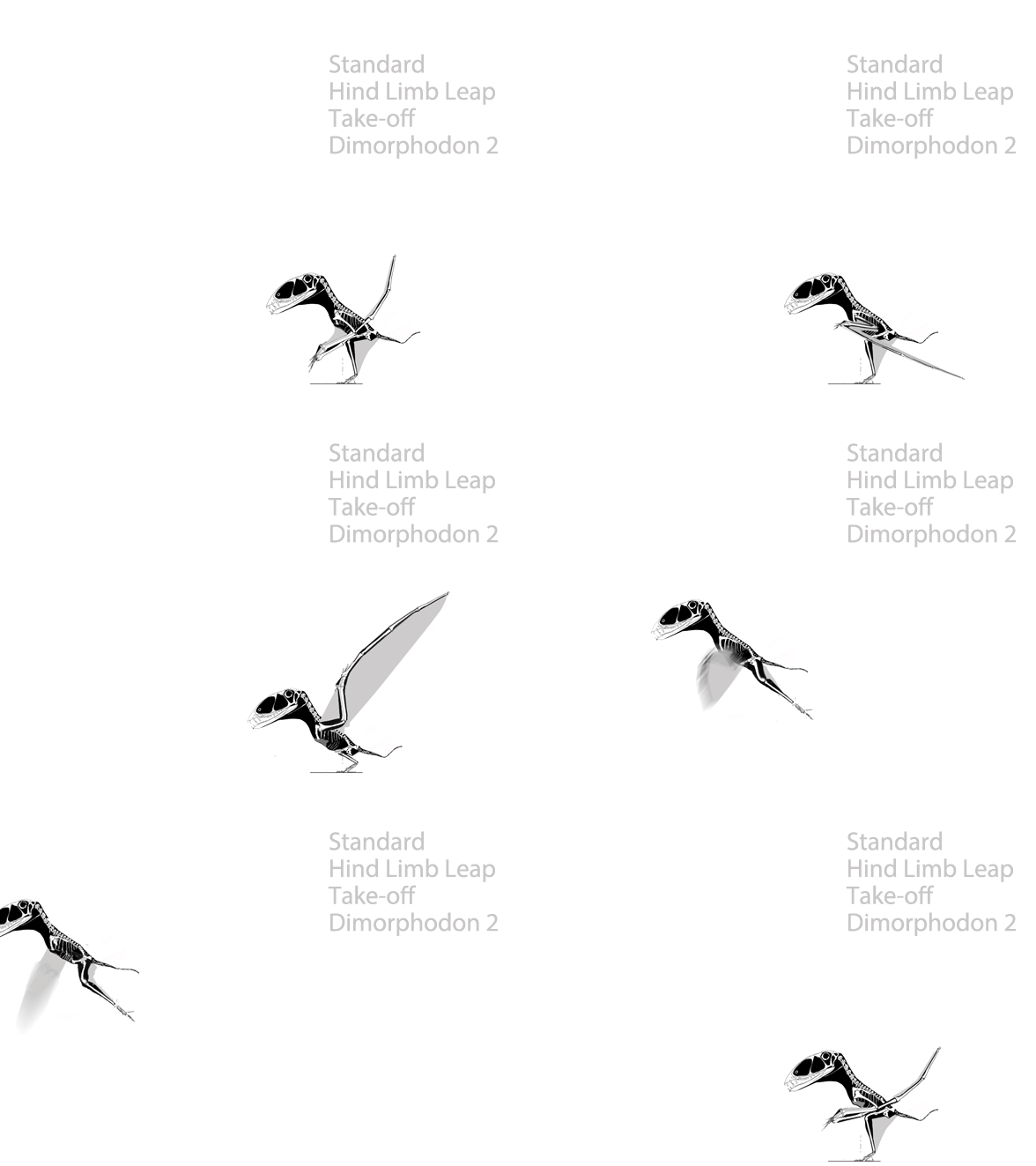
“Here’s a hypothesis for Dimorphodon: https://www.reptileevolution.com/dimorphodon.htm  What is impossible in this animation?”

Starting with a more minor issue, the head isn’t facing the proper direction for bird-like take off. Birds, when taking off, have their heads pointing in the direction they’re flying in (Fig. 5) which the Dimorphodon in the reconstruction doesn’t do.

Figure 5. A diagram depicting the body position of a Common Starling (Sturnis vulgaris) during take off (source)

Along with that, there aren’t many myological studies on Dimorphodon I could point to for the musculature in the wings, but what I can point to is how the animation (Fig. 6) fails for the mode of take off you want it to.

Figure 6. David Peters’s animation depicting how he thinks Dimorphodon took off.

Outside of the issue regarding head posture, the Dimorphodon doesn’t really match up with how birds take off.

Firstly, in birds the wing isn’t raised until it begins to launch itself. The Dimorphodon, however, has the wing raised before it even starts to lower itself.

>> Stu. I can cherry-pick, too. Here’s a video of a sea gull taking off with wings exended above before leaping: https://www.youtube.com/watch?v=47e3hK3brUU

Secondly, the ankle of the Dimorphodon in this frame is in a position that would either be biomechanically impossible or would just break the ankle (Fig. 7).

>> Stu, don’t state: demostrate. Show. What angles are valid? What angles are beyond valid? You realize the ankles of Dimorphodon are simple hinges? That means the foot can rotate in a wide arc including beyond the axis of the tibia. I look forward to your data on ankle angles. At the present angle the Achilles tendon is stretched, ready to snap back to create that hop.

Figure 7. The frame in David Peters’s animation where the ankle is not in a correct posture.

Thirdly, the Dimorphodon, when lunging, has its entire body remain in the exact same position, not rotating at all. Birds on the other hand, rotate their bodies to be more parallel to the ground when getting in the position to lunge.

>> Stu. you are correct with regard to the starling drawing. You appear to be so desperate to be correct that you are grasping at straws, There is a cock and load posture in the bird figure you provided. However, in the sea gull video, look for the same when the wings are raised. I don’t see it. That lowering seems to be a minor variable, depending on the situation, not a deal killer.

Finally, birds and pterosaurs have entirely different hindlimb anatomy. The reason why birds can push themselves off the ground like they do in Figure 5 is because their tibiotarsus is at a position which is where the femur is in Dimorphodon. The hindlimb bones of birds are adapted to this method of taking off as they both have the tibiotarsus and the tarsometatarsus. Pterosaurs don’t have those adaptations.

>>Stu: Pterosaurs, like all tetrapods, have a tibia, tarsus and metatarsus. As in birds, the tarsus of all pterosaurs in tiny and produces a single hinge joint – very much like birds that fly. Take a look at these images of pterosaur tarsi: https://pterosaurheresies.wordpress.com/2013/08/12/the-myth-of-the-pterosaur-tibiotarsus/  and https://pterosaurheresies.wordpress.com/2014/01/03/a-near-tibiotarsus-in-two-derived-pterosaurs/ Also take a look at ‘A catalog of pterosaur pedes for trackmaker indentification’ at ResearchGate.net

“Be specific. Pick a genus. Then we can talk. I mentioned this on my earlier reply. Try not to be nebulous like this. And try to avoid using the term “I believe”. Better to say ‘my figure 1 shows’.”

I’m currently writing a different post addressing specific pterosaurs as you requested in your reply before this one.

With all that said, before I fully end this post, I do want to say how I got the images on the post to work. Basically, all I did was use the built-in image feature in the comment options, pressed ‘insert with URL’ and pasted the image address into the box, and pressed enter. Here’s some visuals for it:

>> Stu: unfortunately when I acccess the comments box, no options are presented. But thanks for that and I appreciate your detailed eye.

Stu Bonk comments 12-22-25

Suprised me,
the images Stu Bonk sent traveled along with his comments!

“I don’t see what you see and I am an amateur 2D animator. For other readers to judge, here is the animation:”

Here they are (if you can’t see them, I can email the screenshots if you’d like):

Thank you, Stu, for providing these images.
This shows an keen interest on your part. Please note the axis of the acetabulum is lateral. The axis of the femora head is medial. Those align. In the animation process the body is one layer. The various leg positions are another layer. Are you saying I was a mm off on the one, but okay on the others?

“I don’t know the ‘actual’ range. What is your precision requirement? This is a crushed fossil. This was the first time on the planet that Sharovipteryx was animated as a biped. The range was set at a little above the prepubis and a little behind it.”

Considering the condition of Sharovipteryx’s fossil, I will give you an exception. I won’t, however, make an exception for any of your animations using pterosaurs as a decent chunk of them are based on taxa with good 3-dimensional remains. Some also have research done into their musculature.

>> Have any done comparisons to lepidosaur musculature? or did they use birds? Or did they use muscle attachment points? If so, how did the prepubis figure into their restorations = best guesses?

“However, your job is not to wonder if I did something wrong, nor to judge based on criteria I was not obligated to, but to repeat what I did and show I did something wrong. In other words: falsify what I did. That’s the scientific method. Be a player, not a spectator. “I’m not convinced” is not a scientific reply.”

3 things:

    1. What you describe as not being part of the scientific method is actually a very common practice in science. This is what peer-review is in a lot of cases.
      >> Peer review rarely if ever employs the scientific method. By that I mean have you ever seen or heard of any referee repeating the experiment (= repeating the animation) or observation = requesting the specimen for their own examination. In my experience referees follow their feelings. One said, “you didn’t look at the fossil long enough.’ On another paper the same referee, David Hone, wrote, “you didn’t examine the specimens a second time.” See what I mean? This is reality. This is gatekeeping. You’re going to have to put away your ideals when it comes to paleontologists. Question: have you ever submitted a manuscript and figures for publication? A Yes or No will suffice.
    1. You use your reconstructions of pterosaur and supposed pterosaur ancestor locomotion when attempting to falsify the scientific consensus around pterosaur biomechanics and locomotion. This means you have the burden of proof to show that this is actually biomechanically possible.
      >> When showing fossils as they lived and locomoted there is no ‘proof’. Only a hypothesis that then requires confirmation, refutation or modification.
    1. By this logic, aren’t you also a spectator when it comes to papers on biomechanics? You haven’t falsified the results from studies on pterosaur biomechanics outside of your beliefs which you haven’t proven to be the case biomechanically.
      >> I presented these arguments in 2011: https://pterosaurheresies.wordpress.com/2011/07/20/seven-problems-with-the-pterosaur-wing-launch-hypothesis/  Please note that when pterosaurs quad launch they do so with wings folded (that makes it tough to use them for thrust and lift as in the competing bird-like launch hypothesis). They do so with wing finger planted on the ground and stretching that tendon so it can snap back when released, like a grasshopper leg. That never happens. Never. Only the free fingers touch the substrate, so no tendon snap.

“Here’s a giant pterosaur running in the manner of Sharovipteryx animated – but using its wings like a fat chicken for thrust and lift – though not enough to fly”

How do you know that type of locomotion would work for an animal that weighs over 300 pounds? Also, considering how heavy the skull is, I doubt Quetz would be able to stably run in that fashion.

>> Doubt is not the scienfic method. Show how Quetz would not be able to stably run in that fashion. How heavy was the skull? What if it was made of something akin to styrafoam or balsa wood? Everything about pterosaurs was extremely thin and supported by needle-like internal struts where necessary. For other readers: animation and other figures are here: https://pterosaurheresies.wordpress.com/2011/07/20/seven-problems-with-the-pterosaur-wing-launch-hypothesis/

“Anhanguera  is much larger and different: it has huge wings that develop lift in a breeze or with thrust.”

My example with Anhanguera applies just as well to any pterosaur you say could run.

>> I say Anhanguera was a poor runner based on having the smallest feet relative to body size of any pterosaur. Worse than all other pterosaurs.

“Also note the extremely small feet on Anhanguera (linked above). Those feet are not made for running. They are vestiges.”

How on earth are the feet vestigial? This is not an aquatic animal nor is it a snake. An animal like Anhanguera will always have to use its feet no matter what. It still needs to nest. When young, they still need to use their feet to move before they can learn how to fly. After landing, they still need to use their feet to take off. Also, I don’t think any of the sediments Anhanguera has been found in are open ocean as the Romualdo Formation is on a shoreline while the Kem Kem Beds are freshwater.

>> Take another look at those feet. They are, if not vestiges, minimized. When young pterosaurs were able to fly shortly after hatching. They had the proportions of an adult only 8x smaller. That is a rule that has not yet been broken based on available data. See: http://www.reptileevolution.com/anhanguera.htm

“Please remember that pterosaur wing membranes are embedded with fibers. Those on Cosesaurus are extremely short and rudimentary. We are lucky to have them. Baby steps.

Pterosaur wing membranes are made up of fibers, yes, but those fibers aren’t the same as the pycnofibers present also on pterosaurs and you depict Cosesaurus with.

>> ‘Those fibers are not the same’ is not an argument. It’s a denial without evidence. Please present data in the form of images from the fossil in Barcelona or your interpretation of photos. To your point, those fibers are shorter, as expected in a transitional taxa. Baby steps = microevolution. Feathers did not appear ready for flight on birds either.

“All reconstructions of mine show the feet placed beneath the center of balance = shoulder joint in pterosaurs, as in birds.”

Henderson, 2024 found the center of gravity/mass on pterosaurs and different groupings of pterosaurs had their center of gravity in different locations with them not always being beneath the shoulder. 4 of the 18 tested pterosaurs had their center of mass directly beneath their shoulder joint: Pteranodon, Nyctosaurus, Anhanguera, and Thalassodromeus. (the paper isn’t open access, but I do have the pdf if you want it)

>> Please provide titles with citations, especially with authors with common last names. I presume you mean “Using your head — cranial steering in pterosaurs”, abstract available on ResearchGate.net. Please note that Henderson is fond of using freehand cartoons for his pterosaurs and gives them deep chord wing membranes attached to the ankles. That gives him no authority to determine center of balance. Please drop Henderson a note and inquire why he employs cartoons in science. And ask his referees and editors why this is permitted and encouraged.

“I note you did not mention that competing quad-launch hypothesis for pterosaurs. It was based on cheating the anatomy of pterosaurs, (SEE LINK ABOVE)”

I’m glad I’m writing this reply late or else I wouldn’t have been able to make this point. A new paper came out a few days back (Ceroula et al., 2025) which I sent you via email when it came out. The paper found that the bending strength index and axial strength index of pterosaur humeri and femurs were in line with both quadrupedal locomotion and the quad launch hypothesis. One thing that the paper found is that the indexes for the humeri and femurs in pterosaurs were similar to many modern quadrupedal animals (e.g. white rhino, water buffalo).

>> Did I read this correctly? Pterosaurs were compared to rhinos and buffalo? In any case, their figure 1 shows a Rhamphorhynchus about to take a drink of water – and a freehand cartoon as well. It is not in the configuration of a bipedal lizard. And they don’t fly!! Please write to the authors demanding more accurate drawings based on specific data.  Here are standing rhamps reconstructed bone-by-bone: http://www.reptileevolution.com/rhamphorhynchus-to-scale.htm  Here is a basal pterosaur, Bergamodactylus. Show me how this pterosaur locomoted quadrupedally: https://www.reptileevolution.com/MPUM6009.htm

“those muscles did not need to be strong enough to push the entire body off the ground. Flapping wings producing thrust and lift helped, as in birds. And to your query, how high is needed? 1cm? 10cm? a meter? Please be precise.”

In hindsight, that was a dumb point to make as you are right, birds don’t need to fully rely on propulsion from their hindlimbs to take off. The better question that I should’ve asked is “how do you know that the wings of pterosaurs could beat fast enough and with enough force to take off in the same manner that birds do?”

>> Which pterosaurs? Which birds? Be specific. Some of both could not fly. Others beat quckly. Others beat slowly. Here’s a hypothesis for Dimorphodon: https://www.reptileevolution.com/dimorphodon.htm  What is impossible in this animation?

“At present you seem to be indicating that pterosaur could not fly in the manner of birds = flapping.”

I only believe that when it comes to taking off from the ground. But when they were flying, they could flap, but they likely flapped less frequently than birds.

>> Be specific. Pick a genus. Then we can talk. I mentioned this on my earlier reply. Try not to be nebulous like this. And try to avoid using the term “I believe”. Better to say ‘my figure 1 shows’.

Anchiornis and feather molting 2025

From the publicity (linked below)
“A new study led by a researcher from the School of Zoology and the Steinhardt Museum of Natural History at Tel Aviv University examined dinosaur fossils preserved with their feathers and found that these dinosaurs had lost the ability to fly. According to the researchers, this is an extremely rare finding that offers a glimpse into the functioning of creatures that lived 160 million years ago, and their impact on the evolution of flight in dinosaurs and birds.”

After analysis
in the large reptile tree (LRT, 2340 taxa), Anchiornis is a feathered pre-bird four nodes more primitive than Solnhofen birds and unable to flap due to its short, squarish coracoids.

Xu et al 2009 described Anchiornis and did not consider it a bird.
Kiat et al 2025 did not include the word ‘coracoid’ in their text. Their study focused on molt patterns, which differ among volant and non-volant taxa.

Kiat et al reported,
“we built two cladograms based on the tree used by Kiat and O’Connor (2024) representing the evolutionary relationships of paravians (including Neornithes), encompassing about 160 million years, including three Mesozoic taxa: Anchiornis, Microraptor and Confuciusornithiformes. Although findings regarding molt strategy have been published for an additional Mesozoic bird, Archaeopteryx, these findings remain disputed74, and therefore, this taxon was not included in our analysis.”

“Two alternative cladograms were required because of the uncertainty regarding the phylogenetic position of Anchiornis, as either a non-avian avialan or a non-avian deinonychosaur. Neornithine evolutionary relationships are based on an
analysis of global bird diversity and the BirdTree project and revised based
on more recent avian phylogeny.”

These are all genomic analyses, so they have maor flaws and do not include fossil taxa. That’s why Kiat et al reported the cherry-picked fossil taxa they somehow added.

Anchiornis huxleyi
(Xu et al. 2009, Late Jurassic, Oxfordian, 34 cm, holotype: IVPP V14378) was originally and correctly identified as a proto-bird. Derived from a sister to Jinfengopteryx, Anchiornis is basal to Aurornis. It has large wing feathers, long leg feathers and short tail feathers, plus a crest of feathers over its head and plumage covering the body.

References
Kiat Y and O’Connor JK 2024. Functional constraints on the number and
shape of flight feathers. Proc. Natl Acad. Sci. USA 121, e2306639121.
Kiat, Y., Wang, X., Zheng, X. et al. 2025. Wing morphology of Anchiornis huxleyi and the evolution of molt strategies in paravian dinosaurs. Commun Biol 8, 1633 (2025). https://doi.org/10.1038/s42003-025-09019-2
Xu X, Zhao Q, Norell M, Sullivan C, Hone D, Erickson G, Wang X, Han F and Guo Y 2009. A new feathered maniraptoran dinosaur fossil that fills a morphological gap in avian origin. Chinese Science Bulletin 54 (3): 430–435. doi:10.1007/s11434-009-0009-6

wiki/Anchiornis

Publicity
The dinosaur that forgot to fly


Softshell turtle phylogeny 2025

Girard and Joyce 2025
created several cladograms for softshell turtles. They wrote, “Softshell turtles (Pan-Trionychidae) are an early branching clade of hidden-necked turtles (Cryptodira) with a rich fossil record extending back to the Early Cretaceous. The evolutionary history of softshell turtles is still unresolved because of their conservative morphology combined with high levels of polymorphism related to morphological plasticity and ontogeny.”

Oops… wrong outgroup. Carettochelys is a leatherback sister, a hardshell turtle. Trionyx arises from Ocepechelon, Odontochelys , Sphodrosaurus and the small horned pareiasaur, Sclerosaurus . Cladogram here: http://reptileevolution.com/reptile-tree.htm

Great to see the digital graphic segregation DGS used here. Let’s settle on a standard set of colors = bones.

References
Girard LC and Joyce WG 2025. The cranial, mandibular, and hyoid anatomy of softshell turtles (Trionychidae): A revised character list for phylogenetic analysis. The Anatomical Record. https://doi.org/10.1002/ar.70101

More answers to Stu Bonk queries and comments

“Stu Bonk indicates splayed hind limbs (which happens when the axes of the acetabulum and femoral head align) would have a limited range of motion in pterosaurs. Please see:”

Quoting Stu Bonk in blue italic
Few things:

    1. There are a few frames in the Sharovipteryx animation where the femoral head is almost entirely detached from the pelvis.  >> I don’t see what you see and I am an amateur 2D animator. For other readers to judge, here is the animation:https://pterosaurheresies.wordpress.com/2021/12/10/sharovipteryx-running-animation/
    2. How do you know this was the actual range of motion of the femur? >> I don’t know the ‘actual’ range. What is your precision requirement? This is a crushed fossil. This was the first time on the planet that Sharovipteryx was animated as a biped. The range was set at a little above the prepubis and a little behind it. The prepubis and anterior ilium anchored femoral adductors developed after the reduction of the femoral abductors = caudofemoralis anchored on the anterior tail. Please note therapsids and mammals also did this by convergence. For videos of other bipepdal lepidosaurs (lacking a prepubis) on YouTube click here .
    3. You didn’t make the gifs in a 3-dimensional space/program nor did you simulate how musculature would actually work in those situations. Due to this, your reconstructions of them running in that motion cannot be considered as evidence because there were no biomechanical restraints put in place, meaning you could have accidentally extended the range of motion too far, put the femur in at the wrong angle making it either too short or too long, made the femoral head move too far out of/within the socket, etc.  >> All semi-valid objections. However, your job is not to wonder if I did something wrong, nor to judge based on criteria I was not obligated to, but to repeat what I did and show I did something wrong. In other words: falsify what I did. That’s the scientific method. Be a player, not a spectator. “I’m not convinced” is not a scientific reply.
    1. In the video of the lizard running, while it is using its hindlimbs for propulsion, it is still very much using its forelimbs to push itself off the ground and forward. Considering that the animals you claim run in a similar fashion are all more heavily built and aren’t as elongated, does it not make sense that pterosaurs especially would have to use their forelimbs for locomotion considering that they all have forelimbs longer than their hindlimbs.” >>  Here’s a giant pterosaur running in the manner of Sharovipteryx animated – but using its wings like a fat chicken for thrust and lift – though not enough to fly:http://www.reptileevolution.com/quetzalcoatlus.htm

It is worthwhile noting that – at speed–  bipedal lizards (videos here) plant their feet far behind their center of balance. Humans do the same. Some call it a controlled fall.

“and pay attention to that YouTube video of a running lizard by the Bruce Jayne labs on that page. Note the wiggling of the hips during each stride AND the wide placement of the feet in dorsal view.”

“However, both the musculature and the general morphology of a zebra-tailed lizard and an Anhanguera are extremely different with the latter being much more heavily built than the former, leading to Anhanguera having much more restraint in regards to the movement of the femur.”Anhanguera  is much larger and different: it has huge wings that develop lift in a breeze or with thrust. Better to compare Anhanguera to a soaring sea bird. Also note the extremely small feet on Anhanguera (linked above). Those feet are not made for running. They are vestiges. Choose your comparisons wisely.

Cosesaurus does have trailing membranes on the forelimbs. Also a pteroid.”

“From all of your skeletals and diagrams of Cosesaurus, the membranes you speak of look much more like filaments and I don’t really see how they are membranes.”  >> Please remember that pterosaur wing membranes are embedded with fibers. Those on Cosesaurus are extremely short and rudimentary. We are lucky to have them. Baby steps.

“Sorry you’ve been misled by other workers that gliding came first in birds, bats and pterosaurs. The anatomy indicates flapping came first. You can flap with little wings before you can glide. And gliding is not a forelimb active mode. Thus, these animals needed to develop flapping first.”

“As a person who tries to keep up with the literature, I wouldn’t say I’ve been ‘misled’. I’ve known for a while that flapping obviously came before flight in birds and non-avian dinosaurs. But here’s the thing: how can you be sure that pterosaurs flapped like birds in order to take off when you haven’t really done anything to prove that its biomechanically possible?  >> Please remember the elongate and locked down coracoid found only in flapping birds and pterosaurs AND their nonvolant ancestors. That translates left-right-left-right into up-down-up-down. Gliders don’t have that. Pterosaurs AND their ancestors also had a sternal complex and a strap-like scapula, as in birds. All reconstructions of mine show the feet placed beneath the center of balance = shoulder joint in pterosaurs, as in birds. That enables the wings to fold and unfold while bipedal. I note you did not mention that competing quad-launch hypothesis for pterosaurs. It was based on cheating the anatomy of pterosaurs, detailed here.

“You haven’t shown that their hindlimb muscles would be strong enough to push their entire body of [sic] the ground, >> those muscles did not need to be strong enough to push the entire body off the ground. Flapping wings producing thrust and lift helped, as in birds. And to your query, how high is needed? 1cm? 10cm? a meter? Please be precise.

“you haven’t shown that pterosaur forelimb muscles are capable of flapping to the same extent as birds without severe strain, you haven’t actually tested for where the center of mass would be in pterosaurs nor if it would be compatible with bird-like flight, and you haven’t shown that pterosaur wings, when flapping and in the air, can function nearly identical to bird wings.”  >> At present you seem to be indicating that pterosaur could not fly in the manner of birds = flapping. Granted, birds have feathers while pterosaurs have a long digit 4 trailed by fibers and tissues. Otherwise, both fold up their wings similarly and have similar shoulder bones by convergence. Let’s be specific. Name the genus you are wondering about. Otherwise pterosaurs range in the size of birds from bee-hummiingbirds to moas. Be specific on genus and indicate your objections to bird-like flapping in pterosaurs with whatever evidence you deem necessary. If it gets lengthy, please direct us to a website that details your thoughts, rather than getting lengthy in the comments section.

Deltatherium: now a didelphid in the LRT

Update 12.16.2025
with the latest iteration of the LRT in which Deltatherium nests as a descendant of Didelphis, as reported when this post was originally published, but also (for the present) nests as the last common ancestor of the Placental 1 clade.

Shelley et al 2021 wrote,
“The dental and cranial anatomy of Deltatherium is a chimera, with morphological  similarities to both ‘condylarth’ and ‘cimolestan’ taxa. As such, the phylogenetic relationships of this taxon have remained elusive since its discovery, and it has variably been associated with Arctocyonidae, Pantodonta and Tillodontia.”

Wikipedia reports, “its relatives are far from clear.”
That usually means taxon exclusion is the culprit. The LRT minimizes taxon exclusion due to its large number of included taxa.

With new data entered into the LRT
on the dorsal skull and the number of possible premaxillary teeth, Deltatherium shifted its nesting spot.

In the process I learned the previous data, an otherwise precise illustration of a skull, restored missing premaxilla parts with imprecision.

In the LRT Deltatherium now nests closer
to Didelphis virginiana and Didelphis marsupialis, rather than the three clades listed above. So, Deltatherium is a big ‘possum’, a little closer to D marsupialis sharing 3 molars.

Shelley et al and other workers did not mention Didelphis in their text, but considered Deltatherium a eutherian = placenta-bearing mammal.
In the LRT it is the last common ancestor of the Placental 1 clade.

This means another case of taxon exclusion hobbling an otherwise informative study.

A little background from Lucas and Kondrashov 2004:
“Matthew (1937) provided a detailed description of the skull and teeth of D. fundaminis and assigned the genus to Arctocyonidae, allying it closely to Chriacus. Matthew considered arctocyonids to be primitive carnivorans (Creodonta), but Arctocyonidae are now assigned to archaic ungulates (Prothero et al., 1988).

“Van Valen (1978, 1988) thought Deltatherium to be the ancestor of Pantodonta, thus deriving pantodonts from a condylarthran stock. McKenna (1975) assigned it to Pantodonta without discussion, a point of view later supported by Sloan (1987). Cifelli (1983) suggested that a Deltatherium-like mammal could be the ancestor of both pantodonts and tillodonts. This idea of the close relationships between Deltatherium
and Pantodonta was rejected by some authors (Zhou et al., 1977; Muizon and Marshall, 1992), but the latter suggested that tillodonts are the sister group of pantodonts. Lucas (1993) stressed the close resemblance between Deltatherium and primitive tillodonts (Esthonyx) and identified Deltatherium as the sister taxon of tillodonts. However, he argued
that tillodonts are not true ungulates because they are not condylarthran descendants. Williamson and Lucas (1993) and Williamson (1996) repeated this opinion, and they included Deltatherium in Tillodontia.”

Lucas and Kondrashove adopted (without testing) the latter hypothesis.
All the above alternatives (except Esthonyx) were tested in the LRT.

Eocene Esthonyx is only known from
teeth attached to jaws – including tusk-like, but not ever-growing incisors typical of tillodonts, distinct from the large, sharp canines and tiny incisors found in Deltatherium.

This new placement in the LRT
was enabled by the recent addition of the common opossum, Didelphis marsupialis as a new taxon. It is found south of Texas to Bolivia, distinct from D virginiana, which is found from Canada to Costa Rica.

D marsupialis has three molars and a relatively shorter, taller skull, as in Deltatherium, distinct from the four molars and longer skull found in Didelphis virginiana.

Similar and related taxa in the LRT include
Ptolemaia  and a much larger Prodinoceras

This appears to be a novel hypothesis of interrelationships.
If not, please provide a citation so I can promote it here.

Sorry, still no relief
from the tech issues preventing uploading or access to my blog library of uploaded images. Housekeeping continues in the mammal subset of the LRT.

References
Cope ED 1881. The Condylarthra (Continued). American Naturalist 84;18: 892–906.
Cope ED 1881. Mammalia of the lower Eocene beds. American Naturalist 15:337-338.
Kerr R 1792. The Animal Kingdom, or Zoological System, of the celebrated Sir Charles Linnæus; being a translation of that part of the Systema Naturæ.
Linnaeus C 1758. Systema naturæ per regna tria naturæ, secundum classes, ordines, genera, species, cum characteribus, differentiis, synonymis, locis. Tomus I. Editio decima, reformata.
Lucas SG and Kondrashov PE 2004. A new species of Deltatherium (Mammalia, Tillodntia) from the Paleocene of New Mexico. In Lucas SG, Zeigler KE. and Kondrashov PE, eds., 2004, Paleogene Mammals, New Mexico Museum of Natural History and Science Bulletin No. 26.
Shelley SL et al (3 co-authors) 2021. Petrosal anatomy of the Palaeocene eutherian mammal Deltatherium fundaminis (Cope, 1881). Journal of Mammal Evolution 28, 1161–1180 (2021). https://doi.org/10.1007/s10914-021-09568-3

wiki/Common_opossum
wiki/Virginia_opossum
wiki/Deltatherium

Panderodus, an Early Silurian conodont from Wisconsin USA

Sorry, still no relief from the WPlink issue in WordPress
so if you want to see Panderodus in situ, click this link: http://www.reptileevolution.com/birkenia.htm and scroll down past this taxon’s relatives in the LRT.

Note: I just learned to add html links to a MSWord doc and copy the lot over. Unfortunately images do not yet copy over.

https://www.myoutube.co/watch?v=GxwEblmPsW0

A recent 12-12-25 YouTube video on conodonts
by Ben G Thomas entitled, “What on Earth were the conodonts” [linked above] explained the history of conodont research and focused on a 2021 paper by Murdock and Smith redescribing Panderodus, preserved with soft tissue – all without revealing the closest relatives of conodonts.

Whenever a video is titled with a question mark, the odds drop that the video creator will answer the question posed.

My comments to the video follow.

After phylogenetic analysis hagfish-like Promissum nests with more fish-like Euphanerops + Drepanolepis and these were basal to more fish-like Birkenia, then Lasanius, then even more fish-like Cheirolepis, then extant Engraulis. This is a separate origin of jaws and teeth from many fish, but this lineage ultimately produced tetrapods and video watchers. So we humans have conodonts in our ancestry, while sturgeons, sharks and catfish do not.

Conodont ancestors include Nuucichthys + Metaspriggina and then older Pikaia and extant Myxine (the hagfish) and extant Enoplus, a marine nematode with radial elements surrounding an oral cavity. That’s as far back as this cladogram goes http://reptileevolution.com/reptile-tree.htm

Lampreys were basal to sturgeons, sharks, placoderms and their descendants.

re: Panderodus – The authors wrote, “However, the presence of the dorsoventral collapse of the apparatus may indicate that the specimen was also dorsoventrally flattened in life and came to rest on a stable body surface.The transverse myomeres would be consistent with this anatomy, in contrast to the acute W-shaped myomeres that would be expected from the dorsoventral collapse of an animal with a laterally compressed body as seen, for example, in Metaspriggina.”

That’s an interesting hypothesis, but the authors also reported, “Eyes are a feature of both the Granton and Soom material but are absent here.”

That is incorrect. Large, typical conodont eyes are visible in the matrix, on either side of a short pointed snout, the preoral lobe in lancelets. By homology conodont teeth are hardened versions of the buccl cirri that extend beyond the oral cavity in lancelets and have a homology in nautilus tentacles and sea cucumber circumoral projections = ambulacra. If Panderodus was dorsoventrally flat, it would be unique among its relatives, which range from tube-like to laterally-flattened.

Donoghue, Forey and Aldridge 2000 employed 17 chordate taxa and 103 characters to determine that, “conodonts are cladistically more derived than either hagfishes or lampreys because they possess a mineralised dermal skeleton and that they are the most plesiomorphic member of the total group Gnathostomata.”

The authors did not realize there is no monophyletic clade Gnathostomata because jaws and teeth developed convergently several times within the Chordata according to the LRT which tests 2340 taxa.

Panderodus unicostatus
(Branson and Mehl, 1933, Smith et al 1987, Murdock and Smith 2021) was an Early Silurian conodont known from the anterior half. The lancelet-like atrium is present. The eyes and preoral lobe were traced using DGS methods. See: http://www.reptileevolution.com/birkenia.htm

References
Branson EB and Mehl MG 1933. Conodonts from the Bainbridge (Silurian) of Missouri. University of Missouri Studies, 8, 39–52.
Briggs DEG, Clarkson ENK and Aldridge RJ 1983. The conodont animal. Lethaia. 16 (1): 1–14.
Donoghue and Forey PL and Aldridge RJ May 2000. Conodont affinity and chordate phylogeny. Biological Reviews. 75 (2): 191–251.
Murdock DJE and Smith MP 2021. Panderodus from the Waukesha Lagerstätte of Wisconsin, USA: a primitive macrophagous vertebrate predator. Papers in Palaeontology. 7 (4): 1977–1993. doi:10.1002/spp2.1389
Smith MP, Briggs DEG and Aldridge RJ 1987. A conodont animal from the Lower Silurian of Wisconsin, U.S.A., and the apparatus architecture of panderodontid conodonts. 91–104. In ALDRIDGE, R. J. (ed.) Palaeobiology of conodonts. Ellis Horwood, 180 pp.

wiki/Panderodus

The splayed leg bipedal locomotion AND flapping before gliding problems answered here

Images and links continue to be on the fritz.
So here’s a reply to a recent comment.

Stu Bonk indicates splayed hind limbs (which happens when the axes of the acetabulum and femoral head align) would have a limited range of motion in pterosaurs. Please see: https://pterosaurheresies.wordpress.com/2021/12/10/sharovipteryx-running-animation/

More info on that anhanguerid pelvis here:

Anhanguera pelvic girdle and femur orientation

and pay attention to that YouTube video of a running lizard by the Bruce Jayne labs on that page. Note the wiggling of the hips during each stride AND the wide placement of the feet in dorsal view.

Other bipedal lizard videos online here: https://www.youtube.com/results?search_query=bipedal+lizard

Stu Bonk also wrote:
“Why would Cosesaurus flap when it has none of the tissue that pterosaurs have? With non-avian dinosaurs, the ones who might have flapped had pennaceous feathers which, for most of them, could be used for some level of gliding, stabilization, display, etc. but Cosesaurus lacks the membrane so there would be no reason for it to flap.”

Why questions are left to speculation:
So, imagine this little guy trying to get a date and ward off rivals and enemies. Flapping for the first time on Earth might impress everyone. Contra your guesses we do know that Cosesaurus had immobile and elongate coracoids + a strap-like scapula attached to a sternal complex = sternum + interclavicle + clavicles, as in pterosaurs, which fused the elements more or less completely. Birds have such coracoids. They indicate flapping. Bats have elongate clavicles because they lack coracoids. Cosesaurus does have trailing membranes on the forelimbs. Also a pteroid. Ellenberger also saw them.

Theropods flapped before flying, like fat chickens, I imagine.

Sorry you’ve been misled by other workers
that gliding came first in birds, bats and pterosaurs. The anatomy indicates flapping came first. You can flap with little wings before you can glide. And gliding is not a forelimb active mode. Thus, these animals needed to develop flapping first.

Sorry you’ve been misled that pterosaur wing membranes
extended to the ankles, as in dermopterans and flying = gliding squirrels. The fact is no one has ever discovered such a pterosaur. If so, I beg you to send me a photo of the specimen. In counterpoint all pterosaur wings stretched between the wingtip and elbow, with a small fuselage fillet back to mid thigh. This is for flapping, but also enables glider plane-like gliding. Long wings came last. Flapping tiny forelimbs came earlier, along with bipedal locomotion and the loss of the short, round sliding coracoid common to other lepidosaurs and basal tetrapods in general – exceptions (birds, bats, pterosaurs) noted above, plus snakes, etc.

Eocene Messelogale: currently close to tiny Triassic Megazostrodon

Sorry, still no pix or links due to the currnet WordPress glitch.
On that point, if you made a comment in the last few days and did not get a reply look for that reply in the next comment by yours truly. The current WordPress glitch extends to comment replies, unfortunately.

According to Wikipedia – Messelogate:
“is an extinct genus of placental mammals from clade Carnivoraformes, that lived in Europe during the middle Eocene.”

The teeth are difficult to see. A µCT scan would resolved this issue.

Currently in the LRT
Messelogate nests alongside the basal mammal Megazostrodon. Earlier Messelogale was matched to tiny Jurassic Hadrocodium, which also shares a long list of traits in common.

So this is a refinement. One of many.

References
https://en.wikipedia.org/wiki/Messelogale
http://reptileevolution.com/reptile-tree.htm